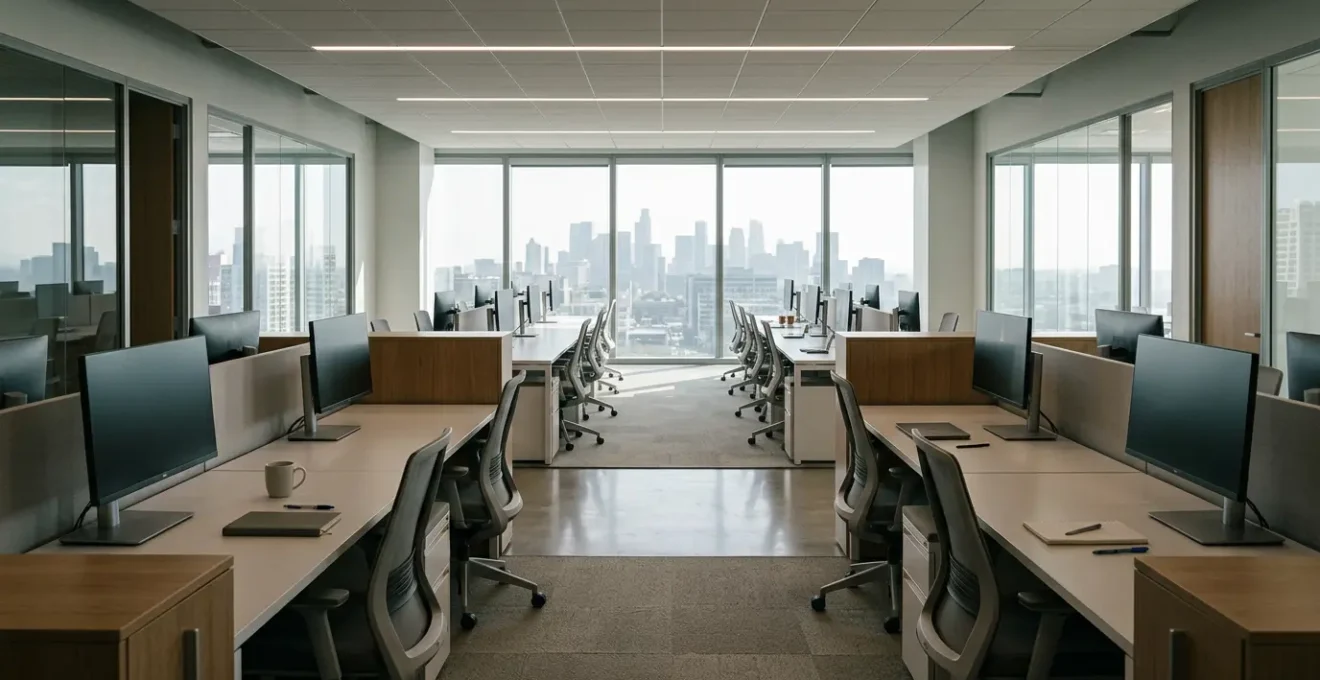
The ‘ghost tenant’ isn’t a sign of a successful lease, but a critical warning that your building is losing its gravitational pull.
- Low physical utilization directly predicts future downsizing and non-renewal, making it a more important metric than contractual occupancy.
- Passive rent collection is an obsolete model; active placemaking is now essential for creating asset value and ensuring survival.
Recommendation: Shift your focus from simply filling space to actively cultivating a vibrant ecosystem that makes physical presence irresistible.
On paper, your commercial asset is performing. Leases are signed, rent cheques are clearing, and the occupancy rate is high. Yet, a walk through the corridors reveals a different story: quiet lobbies, empty desks, and a palpable lack of energy. This is the paradox of the “ghost tenant”—a company that pays for its space but whose employees rarely use it. For asset owners, this phenomenon is far more than a curiosity; it’s a leading indicator of future risk and diminishing value.
The common explanation points squarely at the rise of hybrid work. While this is a contributing factor, attributing the issue solely to remote work models is a strategic misstep. The typical response—adding more amenities like coffee bars or gyms—often fails to address the core problem. These perks treat the symptom, not the disease. The truth is that tenants, particularly their employees, are voting with their feet. If an office or retail space fails to offer a compelling reason to show up, they won’t.
But what if the problem isn’t the tenant’s new habits, but the building’s fading relevance? What if the core issue is a loss of gravitational pull, the invisible force that makes a place a desirable destination? This analysis will deconstruct the ghost tenant phenomenon, not as a lease-level anomaly, but as a critical symptom of declining asset vitality. We will explore how to measure this activation lag, mitigate renewal risks, and ultimately, transition from being a passive landlord to an active place-architect.
This article provides a strategic framework for understanding the forces at play and transforming your high-occupancy, low-footfall asset into a thriving hub. By focusing on ecosystem value over simple lease value, you can build resilience and secure the long-term future of your property.
Summary: Navigating the Challenge of Ghost Tenants and Low Footfall
- Utilization Rate Tracking: How to Know How Many People Actually Come to Work?
- Renewal Risk: Will the Tenant Downsize if Only 30% of Desks Are Used?
- Placemaking Strategies: How to Bring Footfall Back to a Quiet Retail Parade?
- Turnover Rents: Sharing the Risk of Low Physical Occupancy with Tenants?
- Neighborhood Blight: How Empty Neighbors Drag Down Your Occupied Asset’s Value?
- Finding Your USP: Why Should a Tenant Choose Your Building Over the One Next Door?
- Empty Property Rates: When Does the 3-Month Exemption Period End?
- How to Position Your Office Space to Attract Tech Tenants?
Utilization Rate Tracking: How to Know How Many People Actually Come to Work?
The first step in addressing the ghost tenant issue is to move beyond the illusion of contractual occupancy and measure what truly matters: actual, physical utilization. A signed lease guarantees revenue today, but it’s the daily footfall that predicts revenue tomorrow. This gap between contracted space and used space is the activation lag, and quantifying it is essential. The global shift in work patterns is stark; one report indicates that global office utilization stands at just 54%, a figure that should alarm any asset owner.
To gain a clear picture, landlords must adopt modern measurement tools. Gone are the days of manual headcount. Today, the standard involves a suite of technologies designed for precision and privacy. These technologies are crucial for understanding the real-world usage of your asset.

As the image above illustrates, modern occupancy sensors are discreet yet powerful. They provide anonymous, aggregated data on how and when spaces are used. This technology can include:
- Infrared (IR) sensors: Placed at entry points or above desks to count people passing through or occupying a specific seat.
- Wi-Fi and network analytics: Analyzing the number of devices connected to the building’s network to estimate overall population.
- Desk and room booking software: Tracking reservations to understand demand for different types of spaces, from individual workstations to large conference rooms.
This data reveals the true rhythm of your building. It helps identify which areas are over- and under-utilized, peak usage times, and the most popular types of spaces. Understanding that the average peak utilization now stands at 80% shows that the office is not dead, but its use has become concentrated. This insight is not just an academic exercise; it’s the foundation for strategic decisions on space reconfiguration, marketing, and, most critically, tenant retention.
Renewal Risk: Will the Tenant Downsize if Only 30% of Desks Are Used?
Low utilization is not a passive problem; it is an active threat to your asset’s future income. When a tenant’s CFO looks at a balance sheet and sees a massive lease expense for an office where only a fraction of desks are occupied, the conclusion is inevitable. At the next lease renewal, they will not just ask for a discount—they will demand a significant reduction in their footprint. The question for landlords is not *if* tenants will downsize, but by how much.
The scale of this challenge is immense. With approximately 217 million square feet of office leases set to expire in the U.S. alone between 2024 and 2025, a massive recalibration is underway. Tenants now hold significant leverage, armed with precise data on their actual space needs. They are no longer guessing; they know exactly how much space is being wasted.
The trend is already clear. Recent data shows that when companies do sign new leases, they are for smaller spaces. In fact, a CBRE report found that in 2023, the average lease size was 27% smaller than in the previous year. This “flight to efficiency” means a tenant paying for 100 desks but only using 30 will realistically aim to lease a space for 40-50 desks next time, incorporating a buffer for future growth. For the landlord, this represents a 50-60% reduction in revenue from that single tenant.
This isn’t a worst-case scenario; it’s the new baseline for negotiations. Landlords who ignore their buildings’ low utilization data are walking into renewal discussions unprepared. Proactively understanding your tenant’s usage patterns allows you to anticipate their needs, propose creative solutions (like flexible space or reconfigured layouts), and reframe the conversation from “cost-cutting” to “value creation.” Ignoring the data is akin to surrendering before the negotiation even begins.
Placemaking Strategies: How to Bring Footfall Back to a Quiet Retail Parade?
Confronted with the reality of low utilization, passive ownership is no longer a viable strategy. The most effective countermeasure is to actively transform your property from a mere collection of spaces into a vibrant destination. This is the essence of placemaking. It is the deliberate act of creating an environment so compelling that people *want* to be there, not because they have to, but because it offers an experience they can’t get at home. This shift in mindset is perfectly captured by Kinexio Insights:
Placemaking transforms buildings and spaces into destinations, turning real estate from a static product into a dynamic experience.
– Kinexio Insights, Placemaking in Commercial Real Estate
For a quiet retail parade or an under-occupied office building, placemaking means engineering a sense of community and energy. It’s about creating a gravitational pull that attracts not only tenants’ employees but also visitors from the surrounding area. This builds an ecosystem where activity begets more activity. Strategies can range from simple activations to large-scale partnerships.

As seen in the bustling event above, activation is key. It’s about programming the “in-between” spaces—lobbies, courtyards, and walkways—to become assets in their own right. This can include hosting farmers’ markets, pop-up art installations, outdoor fitness classes, or food truck festivals. For retailers, collaborative events are powerful; research shows that promotions and events are a major draw, with some studies indicating they can influence up to 80% of customers. By creating a calendar of engaging events, a landlord becomes a place-architect, building a community that enhances the value of every lease within the property.
Your Placemaking Activation Checklist: From Quiet to Vibrant
- Identify Contact Points: Map all public and semi-public spaces—lobbies, plazas, rooftops, wide corridors—where activation events could be hosted.
- Collect Existing Assets: Inventory current tenant mix (e.g., coffee shop, gym) and nearby community features (e.g., park, theater) that can be leveraged for partnerships.
- Assess for Coherence: Does a weekly yoga class align with your building’s brand as a high-finance hub? Ensure activations match your desired positioning.
- Gauge Emotional Impact: For each idea (e.g., a local artist’s mural vs. a generic water feature), rate its potential for creating memorable, shareable moments.
- Develop an Integration Plan: Start with low-cost, high-impact pilots (e.g., a food truck Friday) and build a 6-month calendar, prioritizing events that involve and benefit existing tenants.
Turnover Rents: Sharing the Risk of Low Physical Occupancy with Tenants?
In a market defined by uncertainty and the “flight to efficiency,” the traditional long-term, fixed-rent lease structure is becoming increasingly fragile. It creates a confrontational dynamic where the landlord’s need for stable income clashes with the tenant’s need for flexibility. A more forward-thinking approach is to create alignment through performance-based lease structures, with turnover rents being a prime example.
A turnover rent (or percentage rent) model consists of two parts: a lower-than-market base rent, which provides the landlord with a secure income floor, and a variable component calculated as a percentage of the tenant’s gross revenue. While traditionally used in retail, its principles are increasingly relevant for office and hybrid spaces. This model transforms the landlord-tenant relationship from a zero-sum game into a partnership. If the tenant thrives—driven by high footfall and business success—the landlord shares in that prosperity. If the business struggles, the landlord shares a portion of that risk.
This structure directly addresses the ghost tenant problem. It incentivizes the landlord to become an active place-architect, as a vibrant, high-footfall environment directly translates into higher turnover for tenants and, consequently, higher rental income. It encourages investment in the very placemaking strategies that make a property a destination. For the tenant, it offers a crucial degree of flexibility and reduces the financial burden of under-utilized space, making them more likely to commit to a physical location.
Case Study: The Financial Logic of Hybrid Workspace Optimization
The logic behind flexible leasing is rooted in the significant cost savings available to tenants. CBRE’s analysis of hybrid workplace models highlights this financial driver. Their findings show that companies transitioning to hybrid work can achieve space cost savings ranging from 10% to 50%. This is accomplished by reducing their overall real estate footprint, improving the utilization of the space they keep, and reallocating budget towards better technology and employee experiences. This desire for optimization is precisely what makes tenants receptive to performance-based lease structures, as it aligns their cost directly with their operational success, creating a perfect opening for landlords to propose shared-risk models like turnover rents.
Implementing such a model requires a greater degree of transparency and trust, including mechanisms for tenants to report sales data reliably. However, it offers a powerful way to bridge the gap between high occupancy and low footfall. By tying rent to performance, you are no longer just leasing square footage; you are investing in your tenant’s success, creating a resilient and mutually beneficial partnership.
Neighborhood Blight: How Empty Neighbors Drag Down Your Occupied Asset’s Value?
The impact of a ghost tenant extends far beyond the four walls of their leased space. An empty or under-utilized unit acts as a negative externality, creating a ripple effect that can devalue an entire building and even the surrounding neighborhood. This phenomenon, often termed “neighborhood blight,” is the macroeconomic consequence of multiple micro-level occupancy problems. When footfall dwindles, the entire ecosystem value of a location begins to decay.
Imagine a prime retail street where two or three storefronts are perpetually dark. The reduced foot traffic makes the adjacent stores less attractive, their sales drop, and they may eventually be forced to close. For an office building, a “dead” floor with no activity makes the entire building feel less dynamic and can deter prospective tenants who are seeking a vibrant, collaborative environment. The problem is contagious. With the national office vacancy rate climbing to 19.2% in late 2023, this is not a hypothetical risk but a present reality in many urban cores.
This creeping blight directly erodes your asset’s capital value. A property’s worth is not just determined by its physical characteristics and rental income but also by the strength of its location and its “co-tenancy”—the quality and vitality of its neighbors. An empty unit next door can reduce the rental value of your occupied space and increase the time it takes to lease any vacancies. The market sentiment is clear, and as Ermengarde Jabir of Moody’s Analytics noted, the pressure is unlikely to ease soon. In a forecast for the year, she stated that the “Office will continue to face the most strain in 2024.”
This underscores the urgency for landlords to think beyond their own property lines. Combating blight requires a collective effort and a place-architect mindset at a district level. This could involve forming business improvement districts (BIDs), collaborating with neighboring landlords on joint placemaking initiatives, or working with local government to implement policies that encourage pop-up shops and temporary uses for vacant spaces. Fighting the impact of your neighbors’ ghost tenants is a crucial part of protecting the value of your own asset.
Finding Your USP: Why Should a Tenant Choose Your Building Over the One Next Door?
In a tenant’s market saturated with options, simply being available is not enough. To combat the forces of downsizing and the allure of remote work, an asset must possess a clear and compelling Unique Selling Proposition (USP). Your USP is the answer to the most critical question a prospective tenant asks: “Why this building, and not the identical one next door for a slightly lower price?” If you cannot answer this question decisively, you are competing on price alone—a race to the bottom.
The market is already signaling what tenants value most: quality. This “flight to quality” is the most significant trend in commercial real estate today. Tenants are willing to pay a premium for buildings that offer superior design, advanced technology, robust amenities, and a tangible sense of community. The data is unequivocal: a CBRE analysis shows that prime buildings, which make up only 8% of total U.S. office inventory by square footage, have accounted for 12% of leasing activity since 2021. They are punching well above their weight.
Your USP is the core of your building’s gravitational pull. It could be rooted in several areas:
- Architectural Excellence & Design: A building with iconic architecture, high-end interior finishes, and abundant natural light.
- Technological Superiority: Best-in-class connectivity, seamless smart building integration (for climate, security, and booking), and certified data security.
- Unmatched Amenity Stack: Not just a gym, but a comprehensive wellness center with classes; not just a lobby, but a hospitality-driven social hub.
- Sustainability Leadership: Top-tier certifications like LEED Platinum or BREEAM Outstanding, which appeal to ESG-conscious tenants.
- Curated Community: A robust program of networking events, educational seminars, and social gatherings that foster a genuine sense of belonging.
This focus on quality is not a landlord’s fantasy; it is a direct response to tenant demand. According to CBRE’s 2024 occupier survey, 59% of respondents are considering or actively executing a relocation to higher-quality space. They understand that the office must be a magnet, not a mandate. By defining and investing in a powerful USP, you move your asset out of the commoditized market and into the premium category where demand remains strong.
Empty Property Rates: When Does the 3-Month Exemption Period End?
While low footfall from ghost tenants presents a slow-burning risk, a completely vacant unit triggers a much more immediate and punitive financial consequence: empty property rates. In many jurisdictions, including the UK, commercial properties that are empty and unused are subject to full business rates after a short exemption period. This period is typically just three months for standard office and retail spaces (and six months for industrial properties).
Once this grace period expires, the landlord becomes liable for 100% of the business rates, as if the property were fully occupied and operational. This is a direct, recurring cash drain that can severely impact an asset’s net operating income. It transforms a non-performing space from a simple lack of income into a significant expense. This policy is designed to discourage landlords from leaving properties vacant for long periods, but in a challenging market, it can feel like a penalty for circumstances beyond one’s control.
This financial pressure further highlights the urgency of minimizing vacancy, even if it means exploring unconventional solutions. The cost of an empty unit is not just the forgone rent; it is the addition of a substantial tax liability. This financial reality should motivate landlords to be more creative and flexible. It might make more sense to offer a short-term lease at a significant discount, allow a pop-up or charity use, or even agree to a turnover-based rent with a very low base, rather than let a unit sit empty and incur full rates after the three-month cliff.
The savings tenants achieve through optimization also play into this dynamic. For instance, Global Workplace Analytics reports that employers can save an average of $11,000 per employee annually by optimizing their workspace strategy through hybrid models. This is money they can re-deploy, and it is the financial incentive driving them to downsize. For the landlord, this means the risk of a tenant leaving to capture those savings—and leaving you with an empty rates bill—is very real. The key is to find a middle ground that allows the tenant some of this efficiency gain while keeping the space occupied and off your tax bill.
Key Takeaways
- Physical under-utilization is the leading indicator of future lease downsizing and non-renewal risk.
- Placemaking is no longer a ‘nice-to-have’; it’s a core strategy to create “destination” assets with gravitational pull.
- The future of leasing involves shared-risk models like turnover rents that align landlord and tenant interests.
How to Position Your Office Space to Attract Tech Tenants?
In the quest to increase asset vitality and secure long-term value, attracting tenants from dynamic, forward-thinking sectors is a powerful strategy. The technology sector, despite being the pioneer of remote work, remains a crucial source of demand for office space. However, tech tenants are arguably the most discerning. They are not looking for a place to house rows of desks; they are looking for an ecosystem that fosters innovation, collaboration, and culture.
To attract these tenants, a building must be more than just a structure; it must be a platform. The “flight to quality” is particularly pronounced in this sector. Data shows that 16% of tech sector leasing since 2021 was in prime buildings, demonstrating a clear preference for high-quality environments. Positioning your space for this market requires a focus on three core pillars: flexibility, technology, and community.
First, flexibility is non-negotiable. Tech companies scale and pivot quickly. They need lease terms that can adapt to their changing headcount, from offering expansion options to providing access to on-demand meeting rooms and project spaces. Second, the technological infrastructure must be flawless. This means resilient, high-speed internet, robust cellular coverage, and smart building features that allow for seamless control over lighting, climate, and room booking. A building that is not technologically advanced is a non-starter. Finally, tech tenants crave a sense of community and a vibrant atmosphere. This is where placemaking becomes your most powerful tool. A curated program of tech-focused networking events, industry speakers, and social mixers can make your building the epicenter of the local tech scene, creating a powerful gravitational pull.
This approach acknowledges the reality of modern work. Today, a staggering 89% of organizations have formal hybrid work programs. The office is no longer the default; it is a destination. For tech tenants, it serves as a cultural hub, a place for deep collaboration, and a physical embodiment of their brand. By creating an environment that excels in these areas, you provide a compelling answer to why their employees should choose the office over their home.
To attract and retain high-value tenants in this new era, the first step is to conduct a clear-eyed audit of your asset’s current gravitational pull. Begin assessing your property not just by its square footage, but by its capacity to create a compelling human experience that makes people *want* to be there.